
What I’m Reading
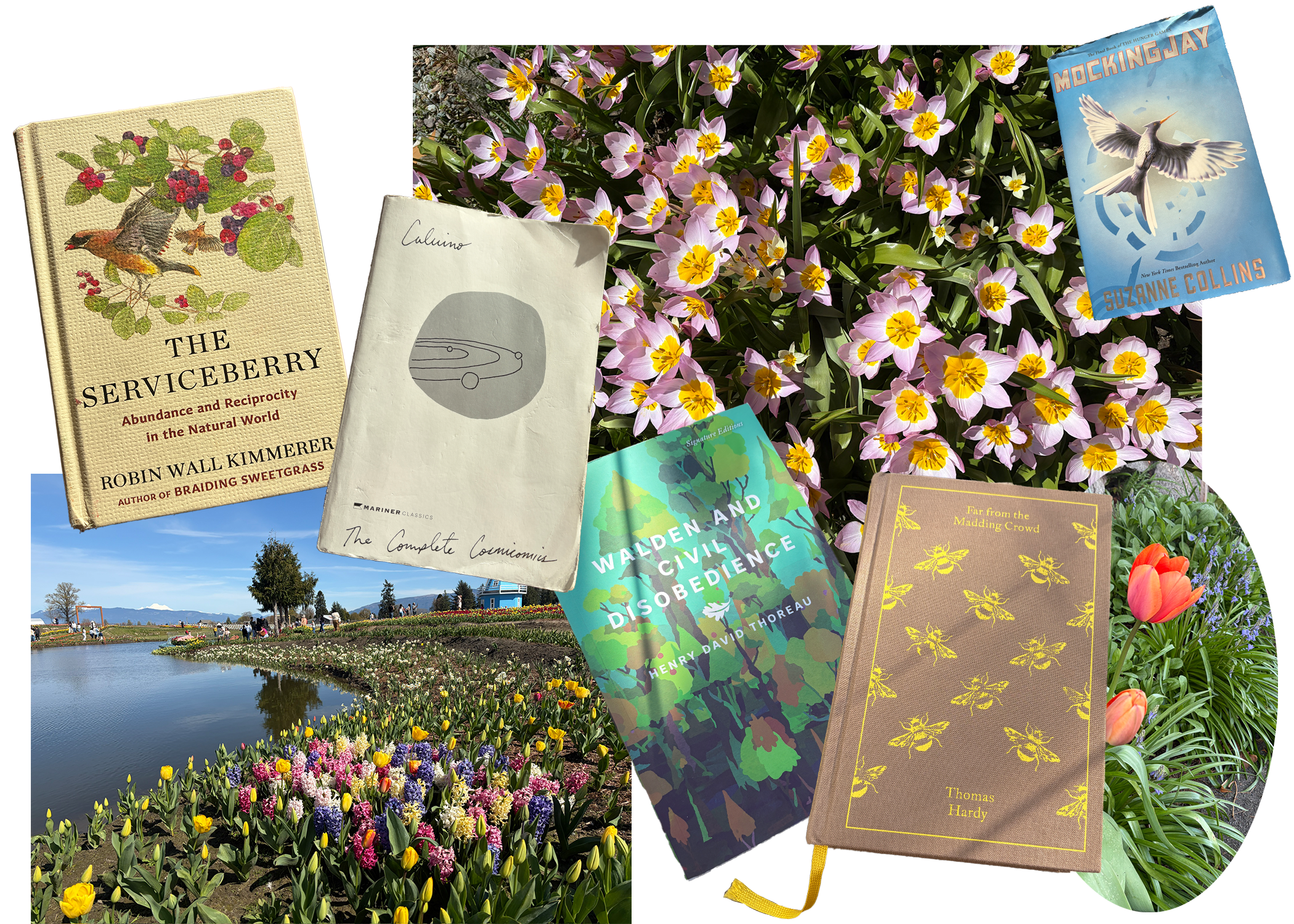
Tulips seem to be in the corner of my eye every day lately.
On a sunny afternoon, while the little gardeners flit about the lawn, tending to their spring prospects, I sit with a book, attempting to drown out the noise of the world. Amidst the warm rays, I contrive this idea to write about all of the books I’ve opened and haven’t found the time or focus to complete. Funny how I’m so distracted from my distractions!
The Serviceberry - Robin Wall Kimmerer
I’m about half-way through this one.
This short book is Kimmerer’s exploration of nature’s economies of reciprocation and gifting. She imagines an ideal economy where currency loses its value in favor of an endless cycle of reciprocity. When an individual takes or consumes a resource, they are compelled to give in a way that continues the cycle. Kimmerer draws analogies using her botanical knowledge and refers to indigenous practices regarding community and ownership (or lack-thereof).
I’ve admired Kimmerer’s work since high school, with my introduction being Braiding Sweetgrass, a book which is on my list to re-read, though in my effort to adhere to the principles of gift-economics, I seem to have misplaced my copy.
While this book could certainly be devoured in a long afternoon, I worry that I will not digest all the wisdom each chapter has to offer. Besides, in between reading, I have been more aware of the parallels between The Serviceberry and my immediate world. One of my hopes for the new year was to establish a gift economy among my friends. Of course, this feels like something that might just have to materialize naturally. Until then, I’ll be seeking niches to fill and relationships to feed.
Cosmicomics - Italo Calvino
I’ve been reading this book for probably two years now, but I can talk about it endlessly. Also, it’s okay that it has taken so long because it’s a collection of short stories!
Italo Calvino is one of the most prolific science-fiction authors and Italian fiction writers. His book Cosmicomics is a series of stories almost completely written from non-human perspectives. It’s a complete headache to read with sentences that span paragraphs, insane timelines that range from eons to milliseconds, and shapeshifting narrators. I’ve never read a more rewarding book.
My favorite chapters (so far) include: the time before the expansion of the universe (“All at One Point”), the dinosaur who lived to become a myth (“The Dinosaurs”), and the mollusk who falls blindly in love (“The Spiral”). Some are an almost insurmountable challenge with my attention span: the infinite chase sequence (“The Chase“), the being trying to communicate with someone millions of light years away (“A Sign in Space”), all of the explorations of cellular reproduction…
I am simply astounded by Calvino’s ability to imagine such alien perspectives. More than once, I’ve googled “what drugs did Italo Calvino use” and still find it hard to believe that none are listed.
I have a feeling that even when I reach the end of this one, I will have just scratched the surface. I just hope that some of his talent is absorbed into my work.
The Hunger Games/Mockingjay - Suzanne Collins
As of right now, Katniss has just been sent into active combat as part of her attempt to promote the rebel cause.
Unsurprisingly, this book is taking far longer to read than the other four (prequels and first two of this series). I definitely don’t want the story to end, and I don’t want certain people to die. It’s silly though, like me not reading the story is going to keep them alive.
I don’t have any regret in finally reading this series. I’m sure I missed out a little on the initial generational bonding experience of reading them all as they were released. I feel like the conversations I have with friends and family about these books don’t reach the depth I am looking for. My hope was that some unique perspective could be gained from reading the books in the chronological order of the story. I fear that the true excitement of this endeavour was unfortunately spoiled by the fact that I’ve already seen all of the Hunger Games movies.
At least when my children are old enough to read the Hunger Games series, we can try again together.
Walden and Civil Disobedience - Henry David Thoreau
I’m about 20 pages into this one so here’s my preassumptive review. Far be it from me to say Thoreau is a bad writer, but he is certainly a complex and difficult one to follow. The cadence of his thoughts has, thus far, been hard for me to latch onto. That said, I am notoriously easily distracted and I could see a reader approaching my writing with the same turmoil and confusion.
There is a lot of wisdom in the woods of Walden and I’m eager to discover it. It’s full of allegory and metaphor that tests my patience and attention. I’m not sure exactly what I’m looking for with this book, but I have a feeling I’ll find many useful things.
Civil Disobedience feels daunting, but extremely pressing and applicable. I’ve lately been hyperaware of my incapability to affect change on the things I see wrong in the world, but I’ve been told this essay addresses similar if not the same issues. I guess I’m treating Walden like a warm-up to Thoreau so I can better understand Civil Disobedience. Expect more writing once I get there.
Far From the madding Crowd - Thomas Hardy
Absolutely my favorite book at the moment and such a pleasant read while the weather is nice. I have no context on Hardy as an author or this book’s place among its historical peers. I also cannot remember now what possessed me to put this on my reading list. I know that I picked it up last year around the same time as Frankenstein, and for a while I was switching between the two, but forgot this one for a bit as other books came along. Only recently have I picked it up and remembered what drew me in to begin with.
Because I want to entice more friends to read Far From the Madding Crowd, I must attempt to hook you with the plot. Imagine a capable young shepherd, dutiful and wise beyond his years, falls in love with a beautiful, spirited girl who tells him she’s no good for him and-oh my god, I just confirmed the connection between Bathsheba (the leading lady of this book) and Katniss. What perfect timing, surely it isn’t a coincidence that I’m reading the two at the same time. Anyway, Bathsheba feels that she can’t be tamed, but to Hardy’s credit, I don’t think she fully will be in the end. So far, the story seems to be an exploration of growth in relationships as the two main characters learn to understand and trust each other.
Initially, I felt like the intense setting and character descriptions were too overbearing to sustain long periods of reading, but I’ve come to appreciate Hardy’s pacing. In contrast to a book like The Hunger Games, where the emotional intensity never ends and action is never more than a page away, Far From the Madding Crowd intentionally slows the pace through thoughtful world-building, and scrutinizing character exploration. I’m left hanging onto every bit of dialogue, which is crisp and clear in the wholeness of Hardy’s Weatherbury.
Far From the Madding Crowd certainly deserves its own lengthy post, and I plan to write it one day. Hopefully my language will be more eloquent and poignant then.
Final Thoughts
If reading is a vice, it’s my best vice. I’d much rather condition myself to turn to a book in times of stress than to anything else, except maybe art. When I read, I can feel myself relearning to focus and slow down. Anxieties seem to creep in when my mind is idle and isolated. Not always, but lately, with all the new things I have to worry about, books have been the safe space I need to process old emotions and fears. There are few things better than the wisdom and guidance of a well-written book.
What are some of your favorites?
